The Credential Portfolio Question Most Institutions Can't Answer
Ask a provost to list every credential her institution issues: degrees, certificates, digital badges, micro-credentials, prior learning transcripts. Most can produce the list without much effort. Ask what each one is built to prove, to whom, and in what market, and the list gets much harder to finish.
That gap matters more now than it did five years ago. Credential Engine's most recent count puts the number of unique credentials offered in the United States at 1,850,034, up from 1,076,358 just three years earlier, growth of roughly 70 percent. Badges alone account for over a million of that total. Every one of those credentials is competing for the same scarce resource: an employer or an admissions reviewer willing to spend the time it takes to figure out what it means.
Most institutions did not set out to build an incoherent portfolio. They added a badge program when a grant required one, launched a certificate when a department wanted new revenue, and layered a stackable pathway on top of a degree when a state initiative asked for it. Each decision made sense on its own terms. None of them were made against a shared answer to what the portfolio as a whole is supposed to signal.
The result shows up in specific, avoidable ways. Two offices issue a badge and a certificate for the same underlying competency, and a graduate has no way to explain to an employer how they relate. A stackable pathway assumes the employer already understands how the pieces build on each other, when the employer has never seen the pathway laid out anywhere. A prior learning credit satisfies a registrar's rule but produces nothing a hiring manager can read as evidence. Multiply any one of these across a portfolio built up over a decade of separate, well-intentioned decisions, and the institution ends up with credentials that quietly compete with each other for the same student's time and the same employer's attention, instead of reinforcing one another.
The cost is not abstract. A credential nobody outside the institution can place gets ignored in a hiring decision no matter how rigorous the work behind it was. Every credential that exists without a clear answer to what it proves is also a line item a board member or an accreditor can reasonably ask the institution to justify, especially as federal earnings-accountability rules put more weight on demonstrable outcomes per credential.
None of this is an argument for fewer credentials or a moratorium on new ones. It's an argument for segmentation: deciding, credential by credential, what it proves, who is meant to read it, and which market it is built for. A badge aimed at a hiring manager needs different evidence attached to it than a badge aimed at a transfer committee. A certificate meant to stack into a degree needs a different design than one meant to stand alone in a job search. Once that decision is made deliberately, an institution can defend why each credential exists, and retire the ones that can't earn their place.
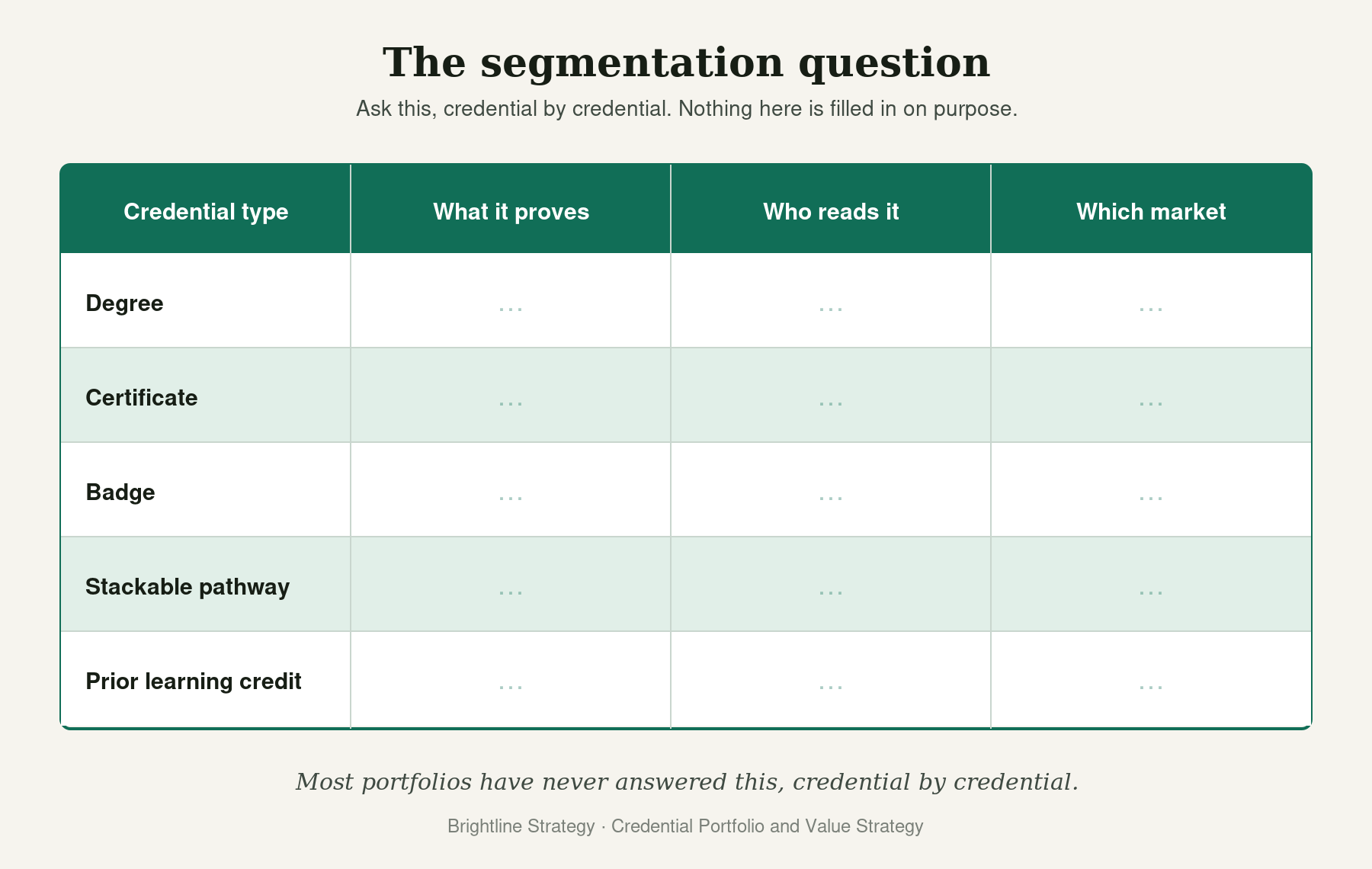
This is a governance question before it is a marketing question. A provost who can say precisely what each credential in the portfolio proves, and to whom, walks into a board conversation about credential expansion, a new program approval, or a state stackable-pathway mandate with an answer instead of a list. The institutions adding credentials fastest right now are not necessarily the ones building value. They are the ones that decided what each credential was for before they built it. That kind of review, credential by credential and market by market, is bounded work, not a wholesale redesign, which is exactly why most institutions have never done it on purpose.