The Demographic Cliff Doesn't Change What to Cut. It Changes How Much Time You Have to Decide.
The peak is behind us.
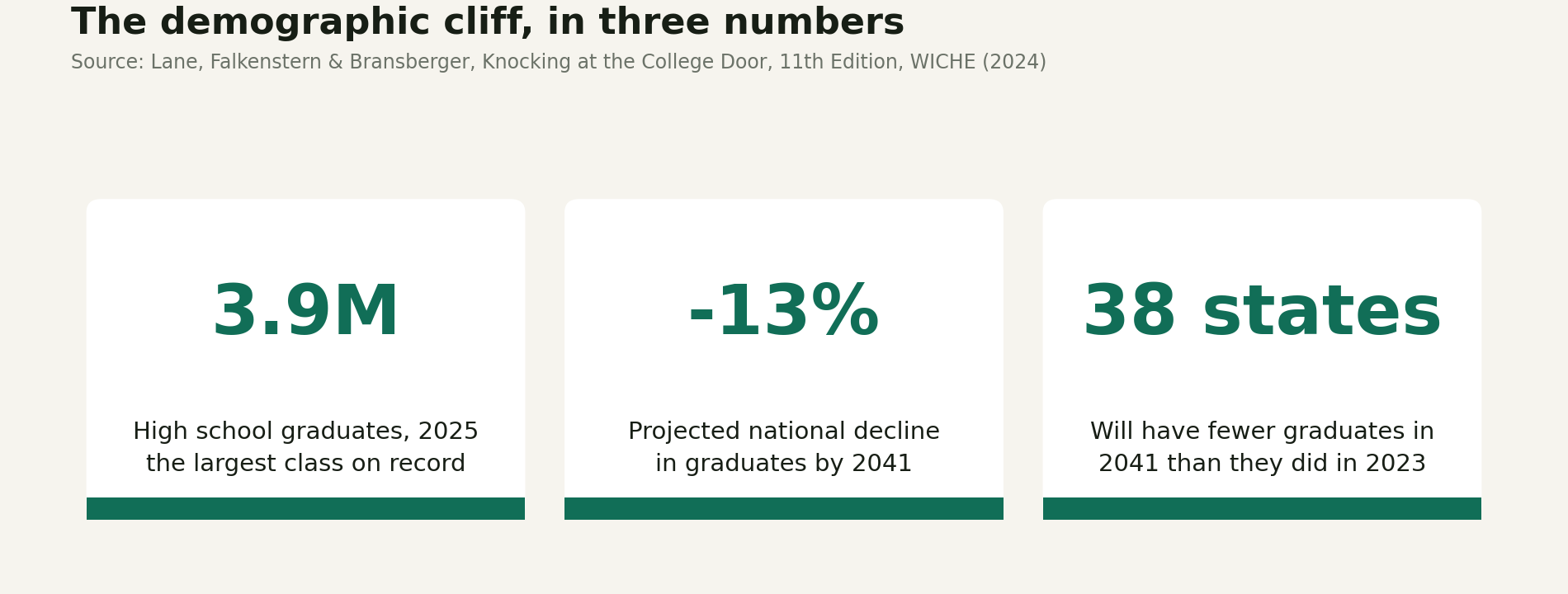
WICHE projected the high school graduating class of 2025 as the largest in U.S. history, at approximately 3.9 million students. From that peak, the number of graduates is expected to decline steadily through 2041, ending about 13 percent lower. Thirty-eight states are projected to have fewer graduates in 2041 than they did in 2023. The decline won't be evenly distributed, but nationally, the direction has changed.
Higher education has been talking about this moment for years. Now we've crossed it.
Most institutions know the projections. They've modeled them, discussed them with boards, and incorporated them into enrollment planning. The harder question is what to do before a smaller applicant pool starts exposing weaknesses that are already sitting inside the academic portfolio.
The cliff doesn't create the portfolio problem. It removes the cover that was hiding it.
In the portfolio reviews I've run, there's a pattern that shows up on almost every campus: a program with weak completion rates or thin labor market alignment, still hitting its enrollment target, because the applicant pool was large enough to forgive it.
That margin is disappearing.
As the pool shrinks, programs that were already struggling will be the first to show it. Institutions that wait for enrollment decline to identify those programs will eventually get the answer. They'll just get it under budget pressure instead of under strategy.
Enrollment decline isn't the decision rule
A program losing enrollment may still be worth keeping. It may be the only pipeline into a licensure-required field the region depends on. It may satisfy an accreditation or grant obligation the institution has already committed to. It may anchor research funding that supports work well beyond the classroom.
A growing program can deserve scrutiny too, particularly if its credential has weak employer value or the revenue it generates doesn't cover what it costs to deliver the program well.
Enrollment tells you something important. It doesn't tell you what to do.
Neither does completion, labor market demand, or margin on its own. Portfolio decisions require explicit criteria and judgment across them. Institutions need to know what they're evaluating, why each factor matters, and where mission or strategic commitments justify a decision the numbers alone wouldn't make.
That work is slower than sorting programs by enrollment change. It also gives academic leaders something they will need when the decisions get difficult: a defensible explanation for why one program received additional investment, another was redesigned, and another was allowed to close.
Delay is also a decision
Boards and cabinets that put this work off are still deciding something. They're deciding who makes the call later, and under what conditions.
A portfolio decision made now, with real data on program performance and workforce alignment, can be an academic decision. Faculty and academic leaders have time to understand what a program is for, what evidence supports it, where it is struggling, and whether the right answer is investment, redesign, consolidation, or closure.
Once declining enrollment has translated into a budget mandate, the conditions change. The institution still has to make choices, but now someone is closing a financial gap on the timeline that year's budget allows.
There will be less room for redesign. Less time to build new programs before old ones weaken. Less ability to distinguish a program that needs investment from one that has simply been protected from a difficult decision.
The demographic shift doesn't tell institutions which programs should survive. That's still an academic and strategic judgment.
What has changed is the amount of time institutions have to make those judgments before financial pressure starts making them instead.
Source: Lane, P., Falkenstern, C., & Bransberger, P. (2024). Knocking at the College Door: Projections of High School Graduates. Western Interstate Commission for Higher Education.