What Your AI Exposure Score Is Actually Measuring
In April 2026, three economists tested something almost no one using AI exposure scores had bothered to check: whether the scores are stable. Michelle Yin and Hoa Vu of Northwestern, with Claudia Persico of American University, ran the same occupational exposure rubric through three frontier models: ChatGPT-5, Gemini 2.5, and Claude 4.5. Same tasks, same occupations, same time period. The models produced a 3.6-fold difference in how exposed a given profession appeared to be, with pairwise agreement between two of the three models as low as 57 percent.
Claude rated accountants as highly vulnerable to AI displacement. Gemini rated the same profession as comparatively safe. Even ChatGPT and Gemini, the two models that agreed most often, still disagreed on roughly a quarter of the occupations tested. The Wall Street Journal covered the study in May, and the lead researcher’s own conclusion was plain: Michelle Yin said she would not rely on a single measure to decide “I should change my job,” or “I should change my kid’s major.”
Most provosts are more cautious than that. But institutions are using exposure scores from research notes, consultancy white papers, and policy reports to justify exactly this kind of decision at the portfolio level: which programs to grow, which to cut, which to redesign. The Yin, Vu, and Persico study is worth sitting with because it doesn’t just say the scores disagree. It shows why.
The Mechanism
The researchers traced part of the disagreement to a specific pattern: occupations with higher current AI usage showed significantly larger increases in measured exposure across newer model generations. Financial analysts who already use AI heavily today get coded as more exposed tomorrow. The training data increasingly reflects how much a profession already uses the tool. It says much less about how much of that profession’s work a machine can actually perform.
That is a feedback loop, and it runs in a specific direction. Early adopters generate the usage data that shapes the next model’s judgment about their own occupation, so the score for that occupation climbs. Occupations with lower current AI adoption, whether from limited access or institutional caution that has nothing to do with task automatability, look artificially resilient by comparison. The instrument is tracking adoption. Institutions are reading the result as if it settled capability.
The Real Problem Is Measurement Validity
This is not primarily a story about AI being hard to predict. It is a story about measurement validity: whether an instrument measures the construct it claims to measure, or something correlated with it that happens to be easier to observe. Psychometrics has a century of vocabulary built for exactly this problem, developed for testing and assessment, and it transfers cleanly here. An AI exposure score built this way has a validity problem before it has an accuracy problem. It is measuring adoption and reporting the result as exposure to displacement.
That distinction changes what the number is allowed to do. A score built to measure adoption can tell you something true and useful: which fields are furthest along in integrating AI tools. It cannot, by itself, tell you which programs will produce graduates whose work is replaceable. A provost who treats the second claim as settled because a vendor report or a single model produced a ranked list is relying on an instrument that was never validated for that decision.
Four Questions Before Acting on an Exposure Score
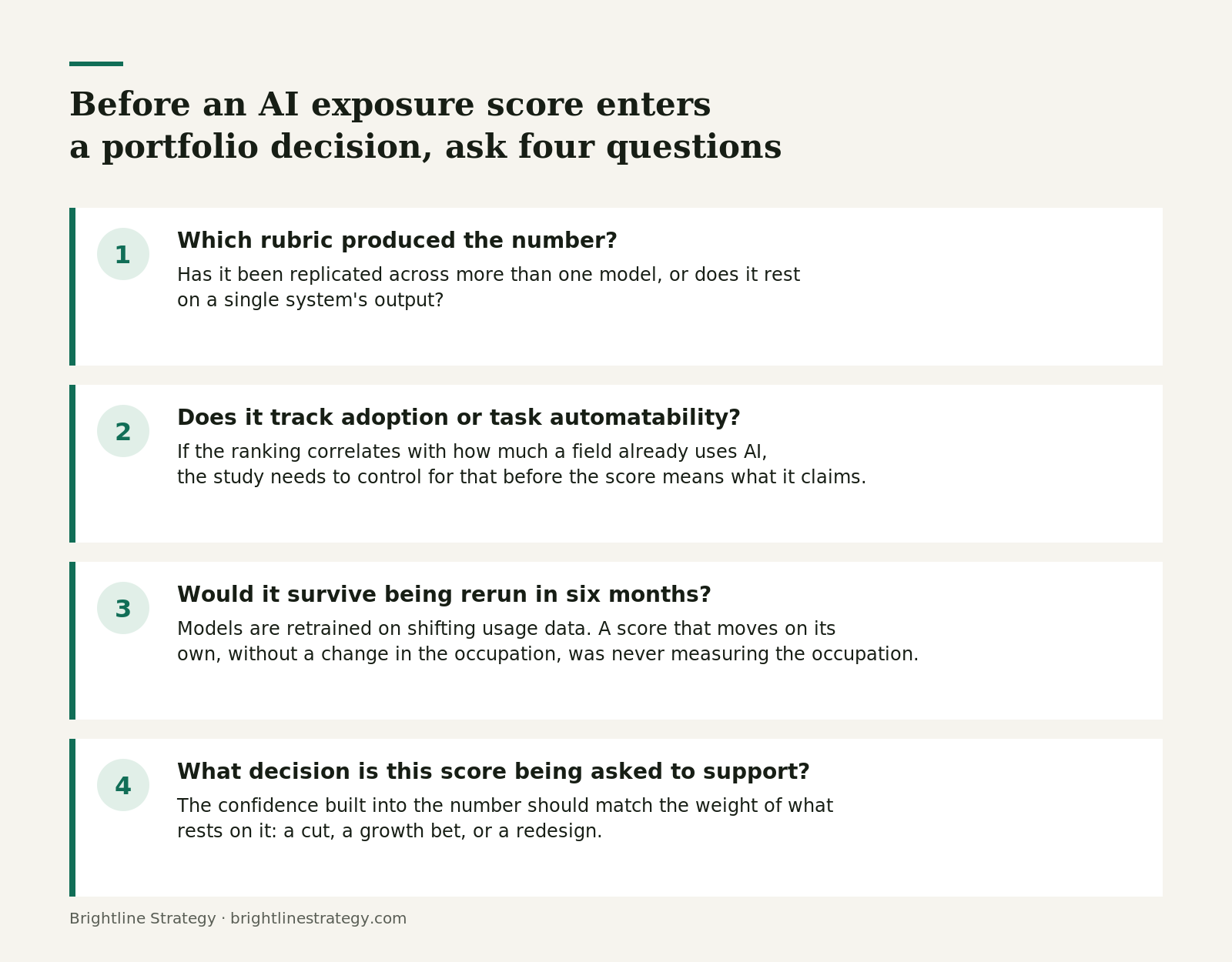
Before an exposure score is allowed to influence a cut, growth, or redesign decision, it is worth running it through four questions. Which rubric produced the number, and has anyone replicated it across more than one model? Does the ranking correlate with current AI adoption in that field, and if so, has the study controlled for that? Would the ranking survive being rerun in six months, given that these models are retrained on shifting usage data, or is the number likely to move regardless of what actually changes in the occupation? And what decision is this score being asked to support, given that the confidence built into the number should match the weight of what rests on it?
A score that fails several of these questions can still be useful context. It should not be the deciding input.
What This Means for Portfolio Decisions
AI exposure scores are not useless. They belong in the same category as enrollment trends and employer demand data: informative on their own, insufficient alone. A portfolio decision built on one number from one model is not a defensible decision. It is an outsourced one, and it will not hold up when a trustee or an accreditor asks what the number actually measures.
The institutions that get this right will not be the ones that found the most authoritative exposure score. They will be the ones that can name what each input in their portfolio decision does and does not tell them, and that can explain the difference between the two. That is a defensible decision. A single exposure score dressed up as one is not.