Workforce Pell Is Final. Most Institutions Are Still Reading the Wrong Test.
The federal rule everyone has been waiting for is done. The Department of Education published the final Workforce Pell regulations in the Federal Register on May 19, 2026, with provisions taking effect July 20 and institutions allowed to implement as early as July 1 if they choose.
Most of the coverage since then has focused on the earnings test. That is not where this gets decided.
Before the earnings test applies to anything, two filters run first, and neither one is about your program.
The first is your institution's own record. The final rule bars any institution that has faced suspension, emergency action, or program termination within the last five years from offering an eligible workforce program at all. This has nothing to do with whether the specific program you want to launch is well designed. It is a question about your institution's recent compliance history, full stop.
The second filter is your governor.
Every eligible workforce program needs two approvals: the state, through the governor or a designated state entity working with the state workforce board, and the federal government. The state goes first. Governors and workforce boards decide which industries and occupations count as high-skill, high-wage, or in-demand in their state, and only programs that clear that state-level filter get forwarded to the Department of Education for review at all.
A program can be exactly what your regional employers need. It can meet every federal quality threshold on paper. None of that matters if it never makes the list your governor's office is building. Governors and state workforce boards are functioning as something close to shadow accreditors for Workforce Pell, deciding the menu of eligible programs before the federal metrics ever come into play. Most national coverage has missed this, because it is easier to write about a national rule than fifty different state processes happening at different speeds.
Once a program clears both filters, three metrics decide whether it stays eligible.
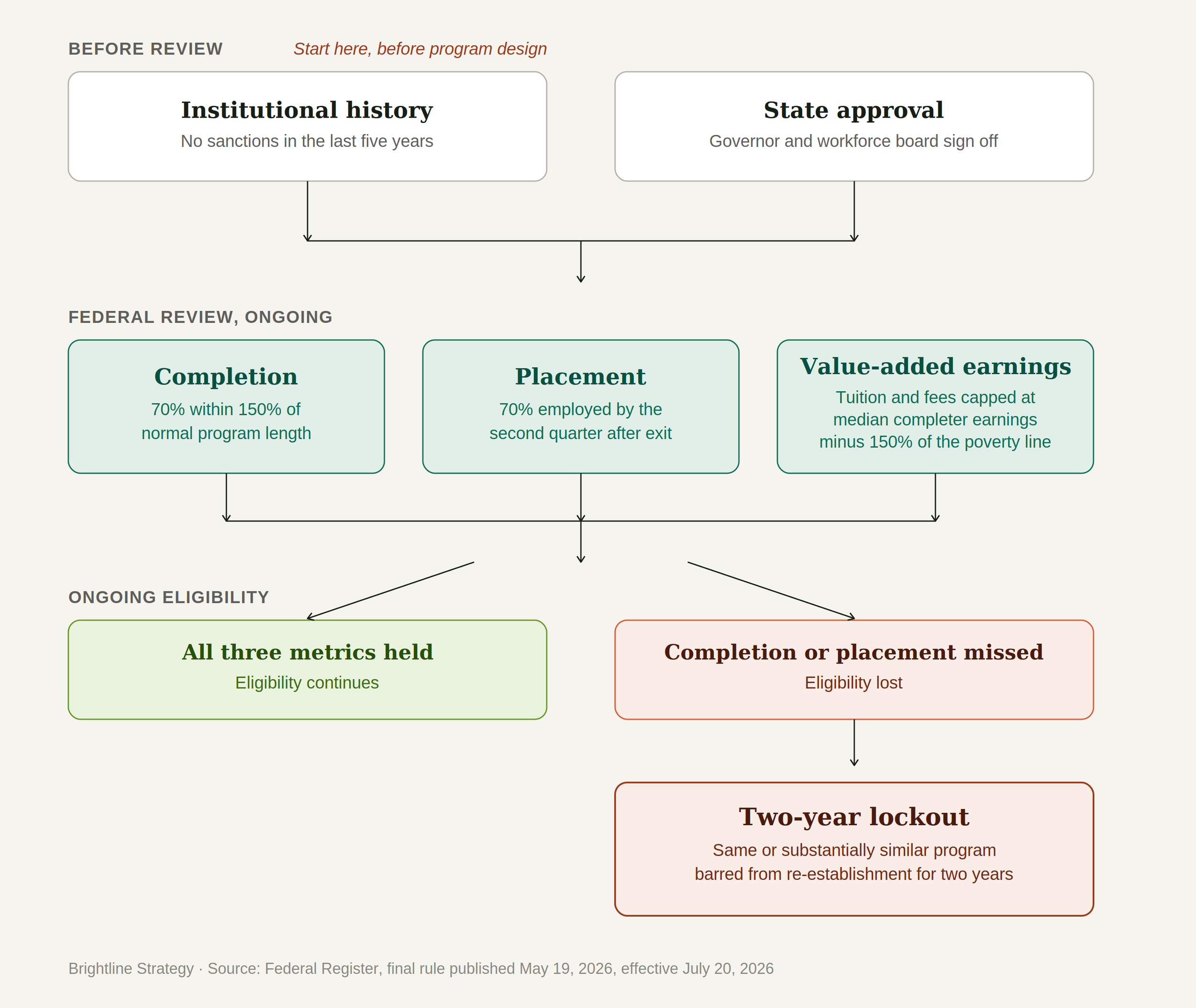
The first is completion: 70 percent of students must complete the program within 150 percent of its normal length. The second is placement: 70 percent of completers must be employed by the second quarter after they finish. The third is a value-added earnings test, and it is the one most explainers oversimplify. Published tuition and fees cannot exceed the difference between a program's median completer earnings and 150 percent of the federal poverty guideline for a single individual. That is not a pass-fail comparison against a high school graduate's earnings, which is how earlier coverage of this rule framed it. It is a tuition ceiling tied directly to the earnings the program actually produces.
This changes the design question. The metric that matters is not whether your graduates out-earn some external benchmark. It is whether what you charge is justified by what your specific program's completers actually go on to earn. Tuition strategy and employment outcomes are no longer separate conversations. They are the same conversation, with a federal number attached.
Here is the part most institutions are underweighting. If a program fails to meet its completion or placement threshold, it loses eligibility, and the institution cannot reestablish that same program, or a substantially similar one, for two years. There is no quick rebrand. There is no minor redesign that lets you back in next semester. The two-year window is the actual cost of treating Workforce Pell as a land grab instead of a pilot.
That changes what a defensible first move looks like. Launching the broadest possible slate of eligible programs in year one, before knowing whether your state will even put them on its approved list, is not aggressive positioning. It is two years of foreclosed options waiting to happen.
Before building anything, the first call should go to your state workforce board, not your curriculum committee. Ask three things directly: which industries and occupations your state has already designated as high-skill, high-wage, or in-demand, what process and timeline your state is using to approve eligible workforce programs, and whether your institution's existing programs already align with a designated sector. The answers determine which programs are even worth designing.
The institutions that get this right will treat the state approval conversation as the first project, not a formality that happens after the curriculum is designed. They will build one or two programs around realistic completion and placement numbers rather than ambitious ones, because the lockout makes an honest first estimate worth more than an optimistic one. And they will price tuition against what their own completers actually earn, not against what a similar program charges somewhere else.
The earnings test is not the hard part. Getting on your governor's list, with a clean compliance record and a number you can actually hit, is.