Why Your Assessments Aren’t Producing Evidence Employers Can Use
An institution launches a competency-based program. The assessments are rigorous by internal standards. Faculty designed them carefully. Students are demonstrating real capability. But when a graduate walks into a hiring conversation and the employer asks what the credential means, neither the graduate nor the employer has a satisfying answer.
That failure pattern is more common than it should be, and it is not a governance problem or a faculty resistance problem. It is an assessment design problem.
Institutions are building competency-based programs, designing skills frameworks, and launching digital credentials, and still producing evidence that employers cannot read. Not because employers are ignoring it. Because the evidence was never designed to travel outside the institution that produced it.
This is the part of credential strategy most consultants skip. Assessment design is technical. It involves questions about validity, reliability, and what it actually means for evidence to be defensible. Those are psychometric questions, and most higher education strategy work stops well before that layer.
The employer’s question is always some version of: can this person actually do the work? The assessment was designed to answer: did this student meet the program’s learning outcomes? Those are related questions, but they are not the same question, and designing an assessment to answer one does not automatically produce evidence that answers the other.
Three design gaps show up most often.
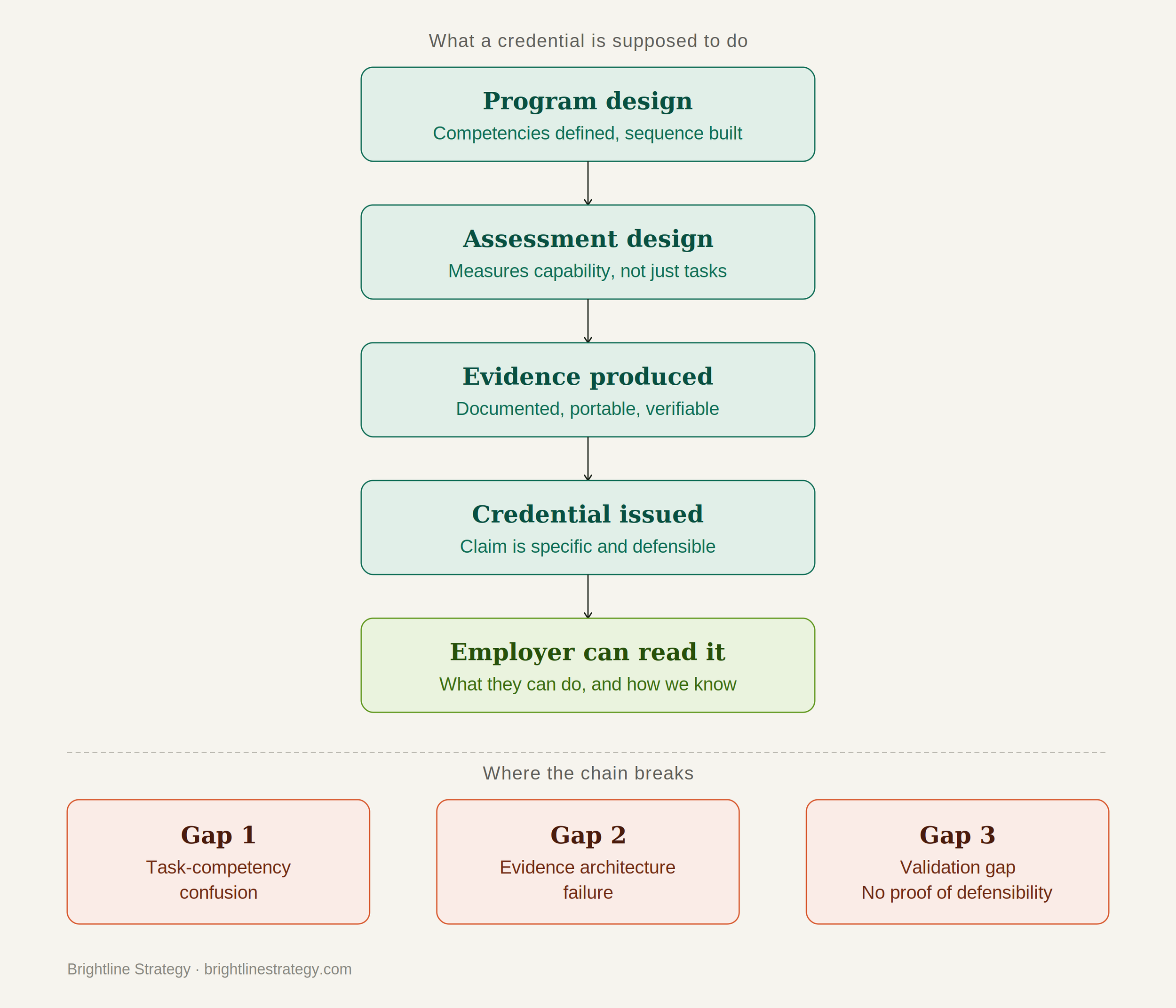
The credential evidence chain, and the three design gaps that break it.
The first is task-competency confusion. Competency-based assessment is supposed to measure underlying capability, the transferable ability to apply knowledge and skill in varied contexts. In practice, many CBE assessments measure performance on a specific task, which is a narrower and less defensible claim. A student who completes a specific project in a specific format under specific conditions has demonstrated something real. Whether that something transfers to a different employer’s context, under different conditions, is a different question, and the assessment design usually does not answer it.
The second is an evidence architecture problem. An institution can have rigorous assessments and still produce no usable employer signal, because the evidence those assessments generate never gets translated into a form an employer can interpret. Assessment results stay inside a learning management system. Competency records live in a format no employer intake process reads. The achievement exists. The evidence of the achievement does not travel.
The third is a validation gap. For an assessment to produce defensible evidence of capability, there needs to be a documented relationship between the assessment and the capability it is supposed to measure. That relationship is what allows an employer, an accreditor, or a federal accountability system to trust the claim the credential is making. Most credential programs cannot produce that documentation, not because the assessments are bad, but because building the validation case was never part of the design process.
None of this is a criticism of the faculty who designed these programs. Validity evidence, evidence architecture, and competency transfer are not topics most faculty development programs cover. These are specialized design questions, and institutions are being asked to answer them without the infrastructure to do so.
What changes when assessment design is done at this level: an employer who encounters a graduate’s digital credential can understand not just what they studied but what they demonstrated, under what conditions, against what standard, with what evidence supporting the claim. The conversation shifts from “what does this credential mean” to “here is what this person can do, and here is how we know.”
That kind of credential legibility requires treating assessment design not as a curriculum decision but as an evidence architecture decision, one that begins with the question an employer will eventually need answered and works backward into the program design.
Three questions worth applying to any CBE or credential program currently in development or under review. First: does the assessment design documentation distinguish between task performance and underlying competency, and can that distinction be explained to a skeptical employer? Second: in what format does assessment evidence leave the institution, and can an employer’s intake process read it without manual translation? Third: is there a documented validation case connecting the assessment design to the capability the credential claims to certify, one that could be produced in an accreditation or employer audit?
If the answer to any of these is no or unclear, the program may be producing rigorous assessments and still failing the legibility test that determines whether any of that rigor reaches an employer.
The gap between what institutions are building and what employers can read is partly a policy problem and partly a cultural lag. But a significant share of it is a design problem. The evidence does not exist in a form that can close the gap, because nobody designed it to.