Why More Credentials Won’t Fix the Employer Confidence Gap
Most large employers have now announced some version of skills-based hiring. The Burning Glass Institute and Harvard Business School examined what actually changed: 11,300 roles at large U.S. firms, looking at hiring before and after degree requirements were removed. The increased opportunity promised by skills-based hiring materialized in fewer than 1 in 700 hires.
Employers are announcing one thing. Their hiring behavior reflects another.
That is usually treated as an employer implementation problem. But higher education has its own version of the problem. Many institutions are creating credentials faster than employers can read them.
The signal problem
A degree communicates something. Not everything employers need to know, but something: duration, persistence, a general field of study, an institutional imprimatur. Hiring managers who have operated within credentialing systems their entire careers know how to interpret it. They may not consciously think about it, but they do it quickly and without friction.
The credentials higher education has been building to replace or supplement the degree often lack that employer-readability. A digital badge in “professional communication” or a micro-credential in “data literacy” requires the employer to do interpretive work that the degree never asked of them. What does this represent? How hard was it to earn? What can this person actually do?
When the answer requires effort, most hiring managers default to what they already understand.
This is not a technology problem. Learning and Employment Records, blockchain credentials, digital wallets: these are infrastructure solutions to an employer readability problem. The infrastructure doesn’t help if the credential itself doesn’t communicate clearly.
What employer readability actually requires
A credential clearly communicates when an employer can answer three questions without looking anything up.
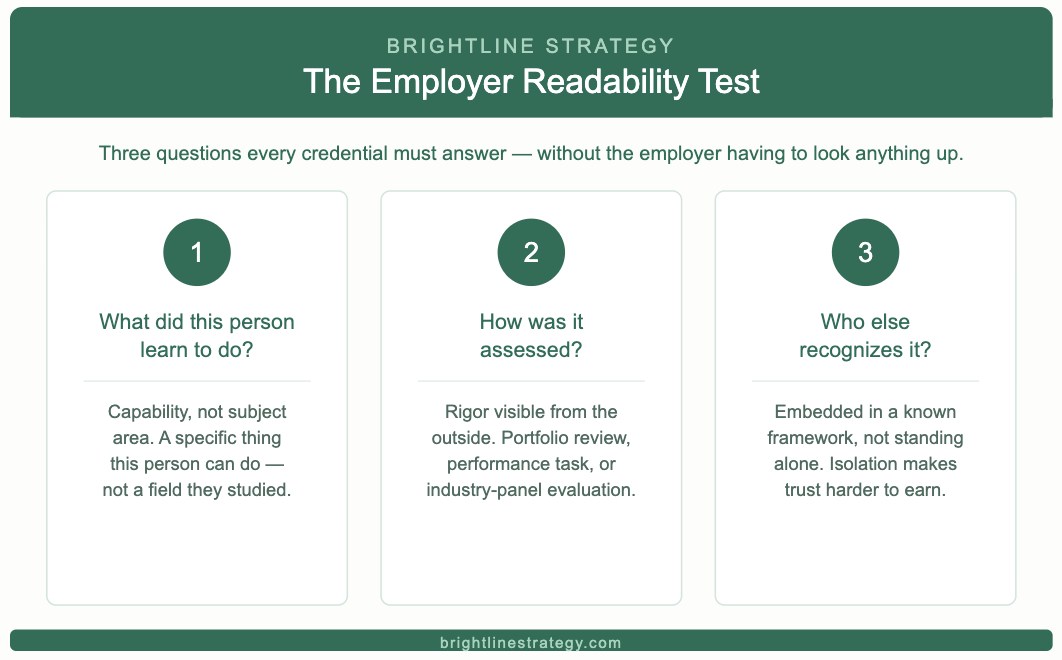
First: What did this person learn to do? Not a subject area: a capability. “Completed 30 credits in business administration” is a subject area. “Designed and managed a client project from kickoff to delivery using Agile methodology” is a capability. The difference is specific and consequential.
Second: How was it assessed? Employers are skeptical of credentials they can’t evaluate because they don’t know what rigor looks like from the outside. A credential that names the assessment method, portfolio review, performance task, or industry panel evaluation provides the employer with a basis for judgment. One that doesn’t leave them guessing.
Third: Who else recognizes it? Credentials that exist in isolation are harder to trust than credentials embedded in a recognizable framework. This is one reason industry certifications often outperform institutional credentials in hiring contexts despite requiring far less time to earn. The employer already knows what the Cisco CCNA or PMP signals mean. They don’t have to do new interpretive work.
Most institutional credentials fail at least one of these tests. Many fail all three.
The design problem institutions rarely name
In the 2026 Lumina-Gallup “Aligning Education and Work” report, roughly 9 in 10 current students said they are confident that their education is building the skills employers need. Only 54% of employers agreed. Nearly 70% said recent graduates require moderate or significant additional training before they can be effective.
Both things are true simultaneously because they measure different things. Students are assessing whether they learned something. Employers are assessing whether they can quickly determine what to do with a candidate. Those are not the same question, and most credential design processes never ask the second one.
Credential design in higher education has historically optimized for internal coherence: the credential reflects the curriculum, the curriculum reflects faculty expertise, and the assessment measures learning objectives. That is a reasonable internal logic. It is not the same as designing for employer readability.
The two are not necessarily in conflict. But closing the gap requires a deliberate move that most institutions haven’t made: designing credentials in conversation with the employers who will read them, not just the faculty who will teach them.
What provosts can do with this
The translation problem is solvable. Adding more credentials to the portfolio is not the solution. Adding credentials that employers can’t read compounds the problem.
Three moves matter.
First, conduct an honest audit of the employer-readability of your credential portfolio. Take your 10 most-enrolled programs and ask whether the credentials they award clearly communicate the capability to employers outside higher education. Not to an admissions counselor, not to a faculty member, not to an accreditor. To the hiring manager who will spend forty-five seconds on a resume.
Second, identify where employer input is actually structuring credential design versus where it’s being collected for advisory optics. A credential advisory board that meets twice a year is not the same as an employer partnership integrated into curriculum mapping, assessment design, and credential nomenclature. The former generates goodwill. The latter generates readable credentials.
Third, take the coming federal earnings accountability environment seriously as a legibility signal. The One Big Beautiful Bill Act, signed July 4, 2025, created an earnings-based accountability test for postsecondary programs, often described as a 'Do No Harm' earnings standard. Programs whose graduates' median earnings fall below those of a typical high school graduate, and that fail this test in multiple years, risk losing access to Direct Loans. Beginning in 2027, the Department of Education will use program-level earnings calculations to flag programs that may lose eligibility as early as 2028. Credential readability is no longer just a market problem. It is a funding deadline.
Credential strategy is not a catalog exercise. It is a trust-building exercise.
The question isn’t whether your institution is building credentials. Most are. The question is whether anyone outside higher education can tell what they mean.
Dr. Sarah DeMark is the founder of Brightline Strategy, an advisory firm focused on academic portfolio strategy for university presidents and provosts. She served as Vice Provost and Interim Provost at Western Governors University and holds a PhD in Psychometrics from Arizona State University.