How to Know Which Programs to Cut, Grow, or Retire
Every provost eventually faces the same uncomfortable meeting. Someone slides a spreadsheet across the table: enrollment trends, program margins, labor market data that may or may not be current. The question underneath all of it is the same: which programs deserve to grow, and which to let go?
Most institutions are making that call without a real framework.
Why the decision is harder than it looks
The data isn’t the problem. Most institutions have access to enrollment numbers, completion rates, and some form of labor-market demand data. But data tells you what happened. It doesn’t tell you what to do. A program with declining enrollment might be a sunset story or a repositioning opportunity. A program with strong enrollment might be succeeding despite a credential that's losing employer relevance.
Programs have champions. Faculty, alumni, and deans have built careers around specific offerings. The portfolio conversation is never purely analytical. It's organizational. Which means the framework you use matters as much as the data you bring to it.
Credential Engine's 2025 report identified nearly 1.9 million unique credentials now available in the United States, offered by more than 134,000 providers. In that environment, knowing which credentials your institution should own and which it should leave to others is a sharper and more consequential question than most leaders realize.
A framework that actually works
After two decades working on academic portfolio strategy inside higher education and with global credentialing organizations, I've found that the most useful framework organizes programs across two dimensions: workforce relevance and institutional fit.
Workforce relevance asks: Does this credential connect learners to real opportunities in today's and tomorrow's labor market? Not the labor market five years ago. Today's. This requires looking at employer demand data, wage outcomes, hiring patterns, and AI exposure risk. The World Economic Forum's Future of Jobs Report 2025 projects that nearly 40% of current skills will need to change by 2030, which means programs preparing learners for roles that will look very different in three to five years deserve particular scrutiny right now.
Institutional fit asks: Does this program align with where your institution is positioned to compete? A program can have strong labor market demand and still be the wrong program for your institution if you lack the faculty expertise, employer relationships, or student population to deliver it with distinction.
When you map your portfolio across these two dimensions, four categories emerge:
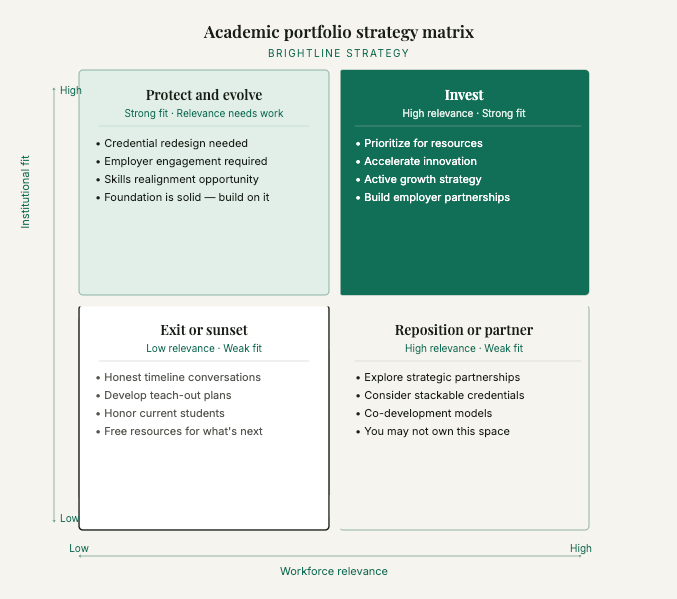
Invest — high workforce relevance, strong institutional fit. These programs deserve resources, investment in innovation, and an active growth strategy.
Protect and evolve — strong institutional fit, but workforce relevance needs attention. These programs have the right institutional foundation but need credential redesign, employer engagement, or skills realignment to stay current.
Reposition or partner — high workforce relevance but weak institutional fit. There may be demand, but you're not the right institution to own this space on your own. Strategic partnerships, stackable credentials, or co-development models may be the answer.
Exit or sunset — low workforce relevance and weak institutional fit. These programs deserve honest conversations: timelines, teach-out plans, and how to honor current students while freeing resources for what's next.
The questions worth asking before any portfolio decision
Before placing a program in any category, four questions are worth answering honestly:
What do employers actually say about graduates from this program, not in surveys designed to produce positive responses, but in direct conversations about hiring, performance, and what's missing?
What does the credential signal to the labor market, and is that signal getting stronger or weaker as the field evolves?
If you were designing this program from scratch today, knowing what you know about where the labor market is heading, would you build it the same way?
What would it take to make this program genuinely excellent, and is that investment the best use of your institution's resources?
What gets in the way
The most common failure mode I see is institutions treating portfolio decisions as one-time events rather than ongoing discipline. A program review that happens every seven years is not a portfolio strategy. It's a compliance exercise.
The relevance gap is real and measurable. Strada-Gallup research found that only 26% of working U.S. adults with college experience strongly agree their education is relevant to their work and daily life. That number should concern every academic leader, not as an indictment of higher education, but as a signal that the alignment between what institutions offer and what learners actually need is still a work in progress.
The institutions that get this right build portfolio governance into their regular operating rhythm. They maintain live data on workforce alignment. They have honest conversations about employer confidence before the enrollment cliff arrives.
The role of leadership
Portfolio decisions ultimately require presidents and provosts who are willing to have hard conversations with boards, with faculty, with deans, before the data becomes undeniable.
The goal isn't to cut programs. The goal is to build a portfolio that genuinely serves learners, demonstrates clear value to employers, and positions your institution for what comes next.
Portfolio decisions are leadership decisions. Waiting is still a decision. It is usually the most expensive one.
If you're navigating these decisions and want to think through your specific portfolio, I'd welcome a conversation.
Dr. Sarah DeMark is the founder of Brightline Strategy, an advisory firm that helps university presidents and provosts make sharper decisions about academic portfolios, credentials, and workforce alignment. Learn more at brightlinestrategy.com.